I am of the idea that the history of the Catholic Church in the last millenium has gone through two eras. Now we are in a third.
From the year 1077 – when the H.R. emperor Henry IV submitted to pope Gregorius VII – to Luther’s reformation, the Church spanned all domains of authority in the Western world. These were the times when the secular power was mostly fragmented into small feudal states, none of whom was able to challenge the others, or the will of the pope. The Sixteenth century overturned this order, owing to the emergence of modern nation states organised upon a greater centralised power. It is in this context that Henry VIII of England founded his own Church, and Frederick III of Saxony gave formal protection to Luther. The decadence of the secular influence of the Catholic Church would have just been a matter of time. It was formalised first by the Peace of Augsburg (1555) and finally sealed by the Peace of Westphalia (1648).
From 1648 to 1958, the Catholic Church has found its prestige and survival in granting the secular absolute authority more legitimacy by means of a sort of celestial projection. (Note: this was even more the case for the smaller religious communities born with the reformation; for some of these it is still nowadays true; but I’m focusing here on the development of the Catholic Church). Popes did not have a say anymore in the nomination of a king or the removal of another, but they were an instrumental complement of the secular power – albeit from a mostly subordinate position. Indeed, a king’s law alone was not yet pervasive enough to control all spheres of the lives of the subjects. Nonetheless, an allmighty God who (over)sees everything – punishing and rewarding accordingly after death – served the purpose very well.
During the three subsequent centuries after 1648, the importance of the Catholic Church was inversely proportional to the degree of pervasiveness that the secular authority had in a given society. Until when obedience and support were better instilled with a show of gilded intimidation, the result was baroque and rococo pedantry. But as soon as the hard power of the French colonial empire and the soft power of the new ideals of the Revolution created the factual conditions to allow it, Napoleon set strongly restricting conditions on the French Church through the concordat of 1801.
Generally, the Nineteenth and early Twentieth centuries proved to be a hard test for the Catholic Church. At a time when technological progress gave the political authority more pervasiveness and the economic capital more concentration, everything metaphisical came to be considered a redundancy. Positivism was the cultural translation of these historical contingencies playing further in favour of the secular power. The Papal States ceased to exist in 1870. Fifty-nine years later, Pious XI signed the concordat with fascist Italy. His successor remained silent on the atrocities of nazism and World War 2.
However, the very same atrocities of WW2, the carefully planned extermination of 6 million civilians, the overnight erasure of entire cities, and the drop of the first atom bomb have shown the bounding limits of the concentration of power, as well as all the unbounded brutality of men when they believe to be God. It is along these lines of argumentation that the Catholic Church has progressed towards a new role, starting with Pope John XXIII (1958-1963). Enough with sterile rites performed in an obscure arcaic language, enough with a gilded show of authority on behalf of others: The new role for the Church had to be found in reverting back to the early and intrinsically Christian intentions of being a spiritual guide towards the good for a global set of believers – which also included some heads of state. It is only on these grounds that the Church could reclaim its autonomy from the secular power, and even regain some influence over it.
In 2013, the election of Pope Francis – of whose death marks today the anniversary – gave a new impulse to this tendency, which was losing momentum in the shade of the unipolar world. In his actions, Jorge Mario Bergoglio has made clear that the Church has to inspire a moral balance to a world in which the pace of technologal advancement might give room for unprecedented accummulation of wealth and power over the nature as well as over other men. Hence, the dignity of every human being should be put forward at the center of the agenda, in line with a new humanism. As this reasoning applies especially to the conditions and suffering of the people in the global South, it gives more impulse to the historical universalist call of the Catholic (i.e. universal) Church. Francis’ successor – Leo XIV – does seem to be in agreement with this view.
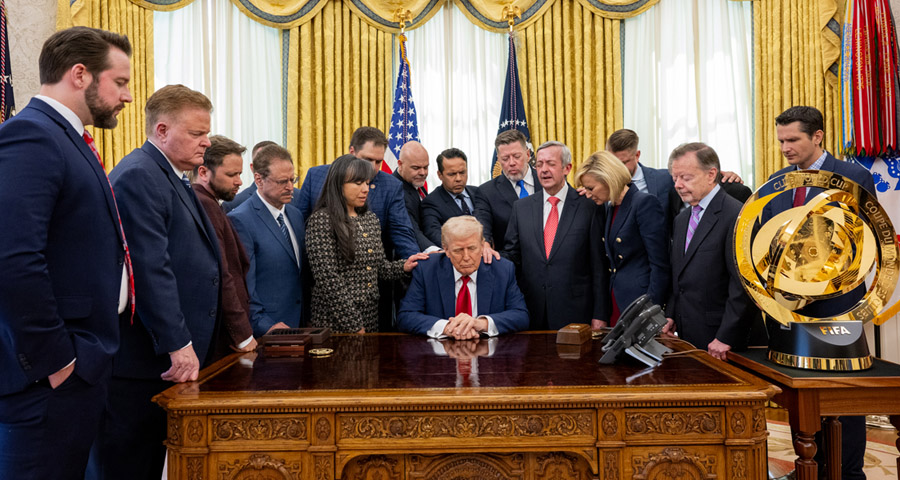
Consequently, it is not surprising that the prince of the authoritarian regression might not be pleased with an idea enhancing the same dignity of all human beings. That is why we have witnessed the first public attack of a head of state against a Pope since the times of Napoleon. Perhaps, what is newer is the current humanism of the Church. Indeed, rather than a subalternity masked in gold, the Church is now showing its role as a supernational organisation that inspires a moral balance to all men, possibly making partially up for national institutions that seem to have conceded to an excessive accumulation of powers. Such autonomy of action of the Church in its originally core competences displeases the nationalists of all complexion, whose distorted narrative includes Christianity as a set of values they defend and advance – but only when serving the obvious purpose of blessing their prince.